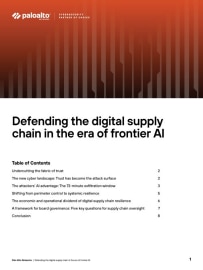
Enterprise security has traditionally focused on defending a well-defined perimeter against external threats. Now, however, the perimeter is blurred as organisations rely on a growing number of third-party relationships to drive business velocity and automation-based efficiency, creating a complex web of third-party tools.
These trusted supply chain relationships are being turned against enterprise security frameworks, transforming them into increasingly significant threat vectors: One in three data breaches now involves a third-party vendor – double the rate of just two years ago.1
Frontier AI only exacerbates this challenge as threat actors leverage powerful AI models to compromise cybersecurity and gain access to sensitive digital assets.
This new CXO whitepaper explores:
- Trust as the new attack surface: the reliance on third-party relationships creates more opportunities for sophisticated, pervasive attacks that offer the returns associated with a one-to-many impact.
- The attackers’ AI advantage: the time from an attacker’s initial access to data exfiltration has collapsed from weeks or days to mere minutes, meaning human-speed defences are no longer fast enough to stop machine-speed attacks.
- How to shift from perimeter control to systemic resilience: organisations need to shift to a new model of continuous, real-time mapping and risk assurance of the entire digital supply chain.
- The economic and operational dividend of digital supply chain resilience: ensuring sustained resilience of the digital supply chain delivers operational benefits that translate into tangible returns, making cybersecurity a verifiable contributor to bottom line as well as overall operational success.
Find out the questions you should be asking and answering to help you secure your digital supply chain in the era of frontier AI.
Download the whitepaper
For more insights, visit Executive Edge, our thought leadership platform for EMEA CXOs.
1 - 2025 Data Breach Investigations Report, Verizon


