Black Box AI: Problems, Security Implications, & Solutions

Black box AI refers to models whose internal reasoning is hidden, making it unclear how they convert inputs into outputs.

6 min. read

Black box AI refers to systems whose internal reasoning is hidden, making it unclear how they convert inputs into outputs.

Their behavior emerges from high-dimensional representations that even experts can't easily inspect. This opacity makes trust, debugging, and governance harder. Especially when models drift, confabulate, or behave unpredictably under real-world conditions.


What do people really mean by 'black box AI' today?

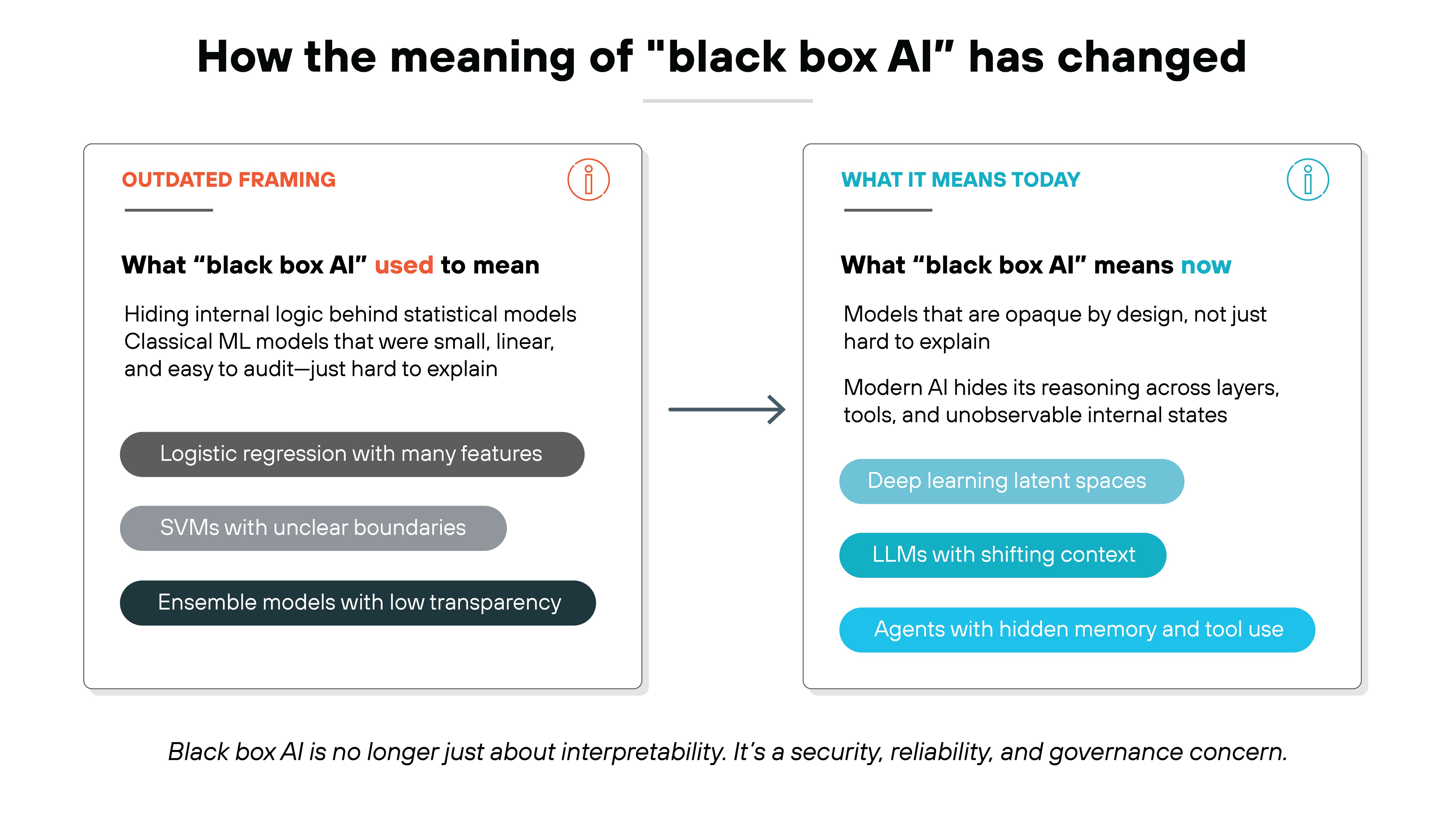
Bold black text at the top center reads 'How the meaning of 'black box AI' has changed.' Two rounded rectangles sit side by side, each containing headers, descriptions, and pill-shaped labels. The left rectangle is titled 'OUTDATED FRAMING' in orange text, followed by a gray underline and bold text reading 'What 'black box AI' used to mean.' Below, paragraph text explains that earlier models hid internal logic behind statistical methods and were small, linear, and easy to audit but hard to explain. Three dark pill-shaped labels appear underneath with the texts 'Logistic regression with many features,' 'SVMs with unclear boundaries,' and 'Ensemble models with low transparency.' An orange circular information icon appears in the top right of this rectangle. Between the two rectangles, a blue arrow points from left to right. The right rectangle is titled 'WHAT IT MEANS TODAY' in teal text with a gray underline and bold text reading 'What 'black box AI' means now.' Below, paragraph text describes that modern models are opaque by design and hide reasoning across layers, tools, and unobservable internal states. Three blue pill-shaped labels appear underneath with the texts 'Deep learning latent spaces,' 'LLMs with shifting context,' and 'Agents with hidden memory and tool use.' A teal circular information icon appears in the top right of this rectangle. At the bottom, italicized text reads 'Black box AI is no longer just about interpretability. It's a security, reliability, and governance concern.'

Black box AI used to mean a model that hid its internal logic behind layers of statistical relationships.

That definition came from classical machine learning. And it made sense when models were smaller and easier to reason about.

But that framing no longer fits modern AI systems. And that's because opacity—the inability to see how models reach their conclusions—looks very different now.

Deep learning models rely on high-dimensional representations that even experts struggle to interpret. Large language models (LLM) add another layer of complexity because their reasoning paths shift based on subtle changes in prompts or context. Agents go further by taking actions, using tools, and making decisions with internal state that organizations often cannot observe.

Which means:

Black box behavior is no longer only an interpretability problem.

It's a security issue. And a reliability issue. And a governance issue.

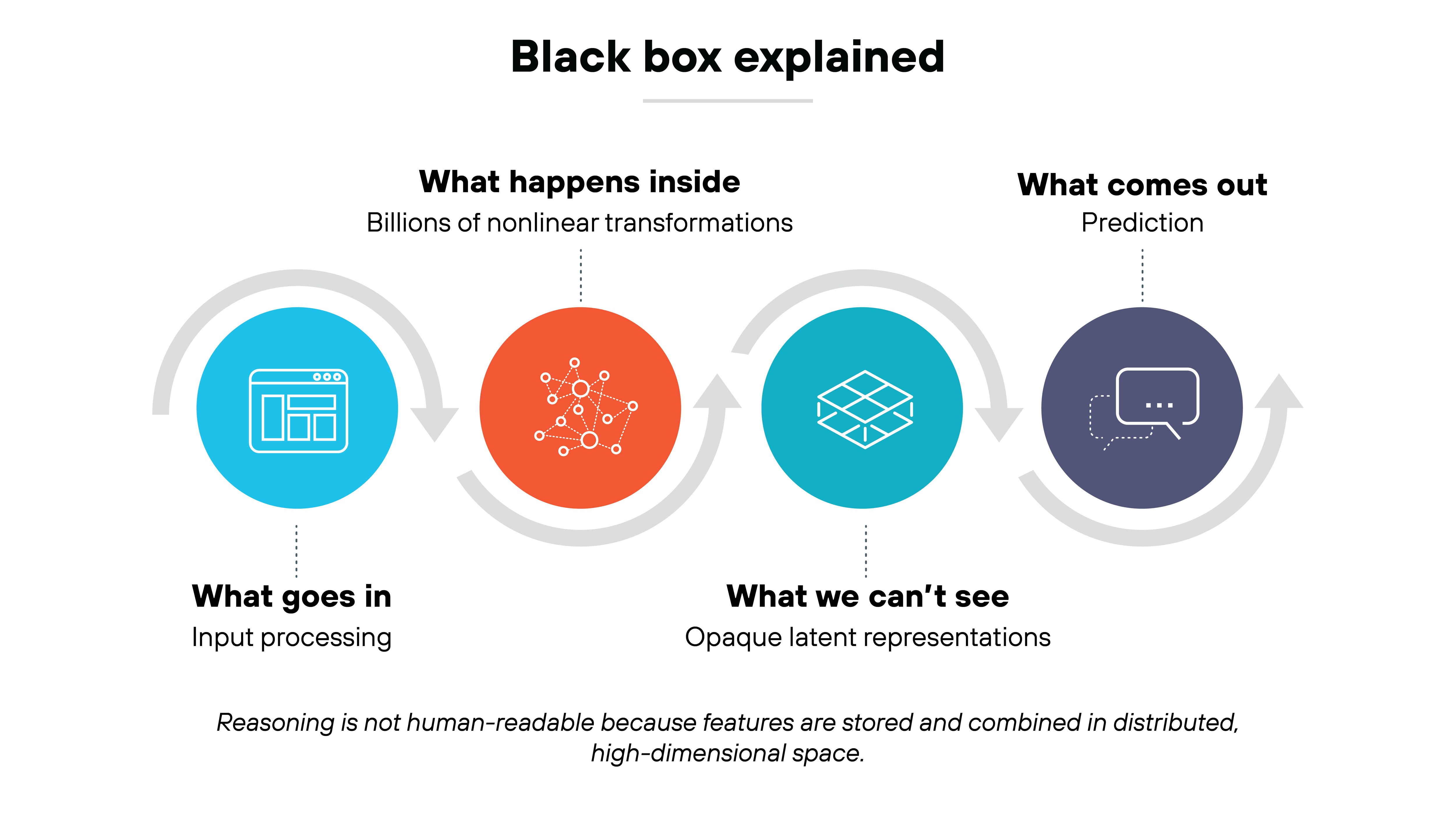
Bold black text at the top center reads 'Black box explained.' Below it, three stages are arranged in a horizontal sequence, each represented by a colored circle with an icon and descriptive text. On the left, a turquoise circle contains a white outline of a web-style interface, labeled beneath with bold text 'What goes in' and subtext 'Input processing.' A large gray curved arrow points from this circle to the center. The center circle is orange with a white network diagram icon of interconnected nodes, labeled above with bold text 'What happens inside' and subtext 'Billions of nonlinear transformations.' A dotted vertical line connects the label to the circle. To the right of it, another turquoise circle contains a white geometric cube-like grid icon, labeled beneath with bold text 'What we can't see' and subtext 'Opaque latent representations.' A gray curved arrow points from this circle to the final stage. On the far right, a dark purple circle contains a white chat bubble icon with dotted outlines, labeled above with bold text 'What comes out' and subtext 'Prediction.' At the bottom center, italicized text reads 'Reasoning is not human-readable because features are stored and combined in distributed, high-dimensional space.'

You can't validate a model's reasoning when its internal mechanisms are hidden. You can't audit how it reached a decision. And you can't detect when its behavior changes in ways that affect safety, oversight, or compliance.

That's why understanding black box AI today requires a broader, more modern view of how opaque these systems have become.


Why do today's AI models become black boxes in the first place?

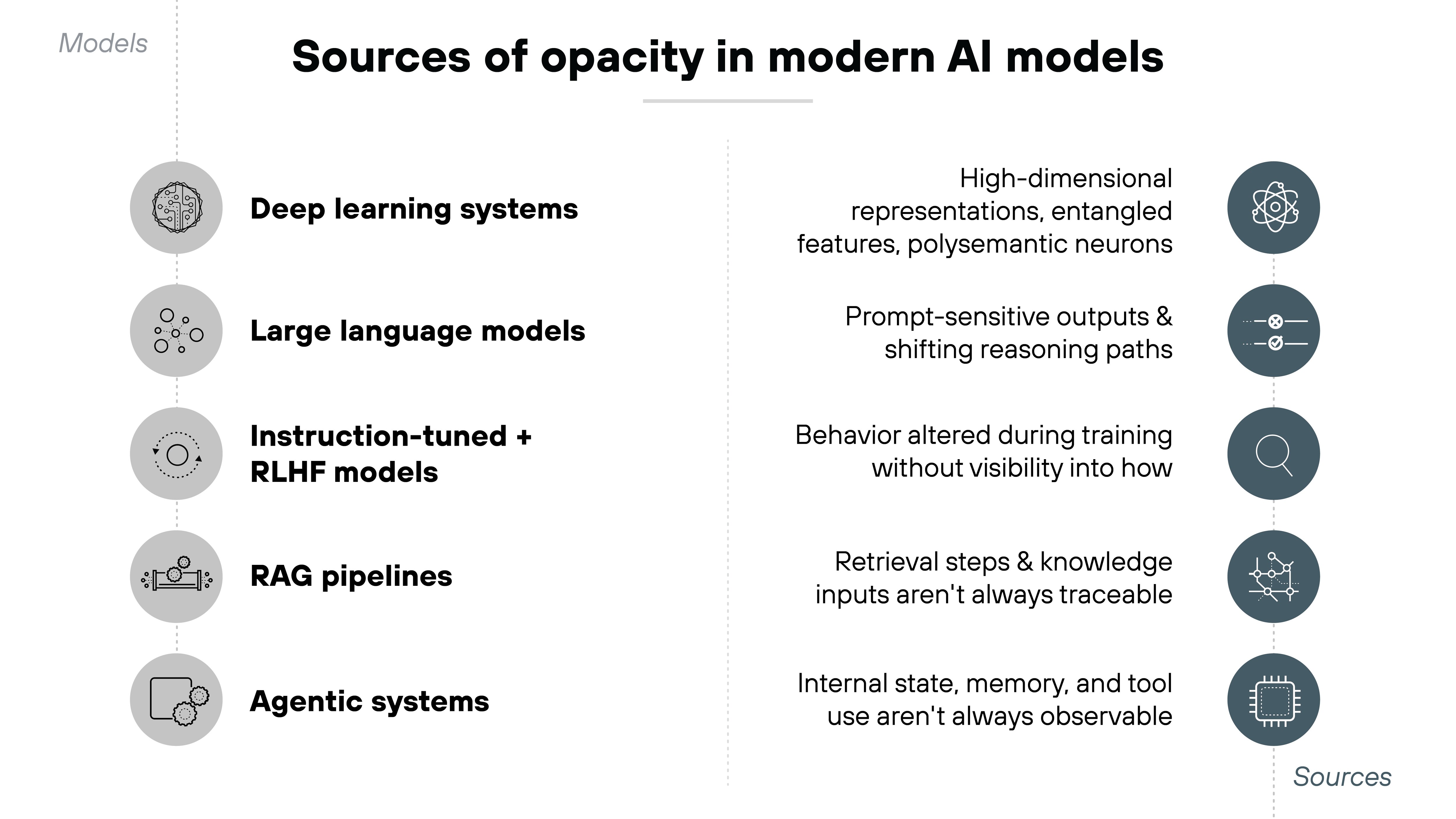
Bold black text at the top center reads 'Sources of opacity in modern AI models.' The layout is split into two vertical columns with dotted guide lines and circular icons. On the left, a gray label at the top reads 'Models.' Beneath it, five stacked gray circles each contain a different line-art icon. To the right of each icon, bold black headings list model categories: 'Deep learning systems,' 'Large language models,' 'Instruction-tuned + RLHF models,' 'RAG pipelines,' and 'Agentic systems.' On the right side of the image, five corresponding explanations are aligned horizontally with teal circular icons. Next to the icon for deep learning systems, text reads 'High-dimensional representations, entangled features, polysemantic neurons.' Next to the icon for large language models, text reads 'Prompt-sensitive outputs & shifting reasoning paths.' Next to the icon for instruction-tuned and RLHF models, text reads 'Behavior altered during training without visibility into how.' Next to the icon for RAG pipelines, text reads 'Retrieval steps & knowledge inputs aren't always traceable.' Next to the icon for agentic systems, text reads 'Internal state, memory, and tool use aren't always observable.' A small gray label in the bottom right corner reads 'Sources.'

AI models seem harder to understand today because their internal representations no longer map cleanly to concepts humans can interpret.

Early systems exposed features or rules. You could often see what influenced a prediction. But that's no longer how these models work.

Deep learning systems operate in high-dimensional spaces.

In other words, they encode patterns across thousands of parameters that interact in ways humans can't easily disentangle. Neurons carry overlapping roles. Features blend together. And behavior emerges from the combined activity of many components rather than any single part

Example:
An LLM asked to 'explain quantum physics to a child' doesn't flip a single 'simplify' switch. Instead, tone, structure, and vocabulary emerge from many interacting components adjusting to context. There's no single part you can point to that causes the shift.

Large language models introduce even more opacity.

Their outputs depend on subtle prompt changes and shifting context windows. Which means their reasoning path can vary even when the task looks the same. Instruction tuning and reinforcement techniques add another layer of uncertainty because they reshape behavior without exposing how that behavior changed internally.

Example:
An LLM that once responded directly may begin answering more cautiously after instruction tuning. The behavioral shift comes from thousands of preference adjustments diffused across the model, not from any identifiable change in a specific component.

Retrieval-augmented generation (RAG) pipelines and agentic systems compound the problem.

They retrieve information. They run tools. They maintain state. And they make decisions that organizations may not be able to observe directly.

All of this creates models that are powerful but difficult to inspect.

It also explains why black box behavior is a structural property of today's AI systems rather than a simple interpretability gap.

| Further reading:


Why is the black box problem getting worse now?

According to McKinsey's survey, The state of AI in 2025: Agents, innovation, and transformation:
  • 88% of survey respondents report regular AI use in at least one business function
  • 62% say their organizations are at least experimenting with AI agents, while 23% percent of respondents report their organizations are scaling an agentic AI system somewhere in their enterprises
  • 51% of respondents from organizations using AI say their organizations have seen at least one instance of a negative consequence, most commonly inaccuracy and explainability failures
  • Yet explainability—while a top risk experienced—is not one of the most commonly mitigated risks

AI models aren't just getting bigger. They're becoming harder to observe and explain. That's not just a scale problem. It's a structural one.

Small models used to rely on limited features and straightforward patterns. But foundation models encode behavior across billions of parameters. Which means their reasoning becomes harder to trace. Even subtle updates to training data or prompt structure can change how they respond.

Then come the agents.

Modern AI systems now take actions. They use tools. They maintain memory. And they perform multi-step reasoning outside of what's visible to the user. Each decision depends on the internal state. And that state isn't always observable or testable.

Retrieval-augmented pipelines add more complexity.

They shift control to the model by letting it decide what external knowledge to pull in. That retrieval process is often invisible. And organizations may not realize what information is influencing outputs.

The rise of proprietary training pipelines is another driver.

Without transparency into data sources, objectives, or fine-tuning methods, downstream users are left with a model they can't verify or validate.

And regulators have noticed.

Recent frameworks increasingly emphasize explainability, auditability, and risk documentation. Which means the expectations are going up. Right when visibility is going down.

PERSONALIZED DEMO: CORTEX AI-SPM
Schedule a personalized demo to experience how Cortex AI-SPM maps model risk, data exposure, and agent behavior.

Book demo


What problems does black box AI actually cause in the real world?

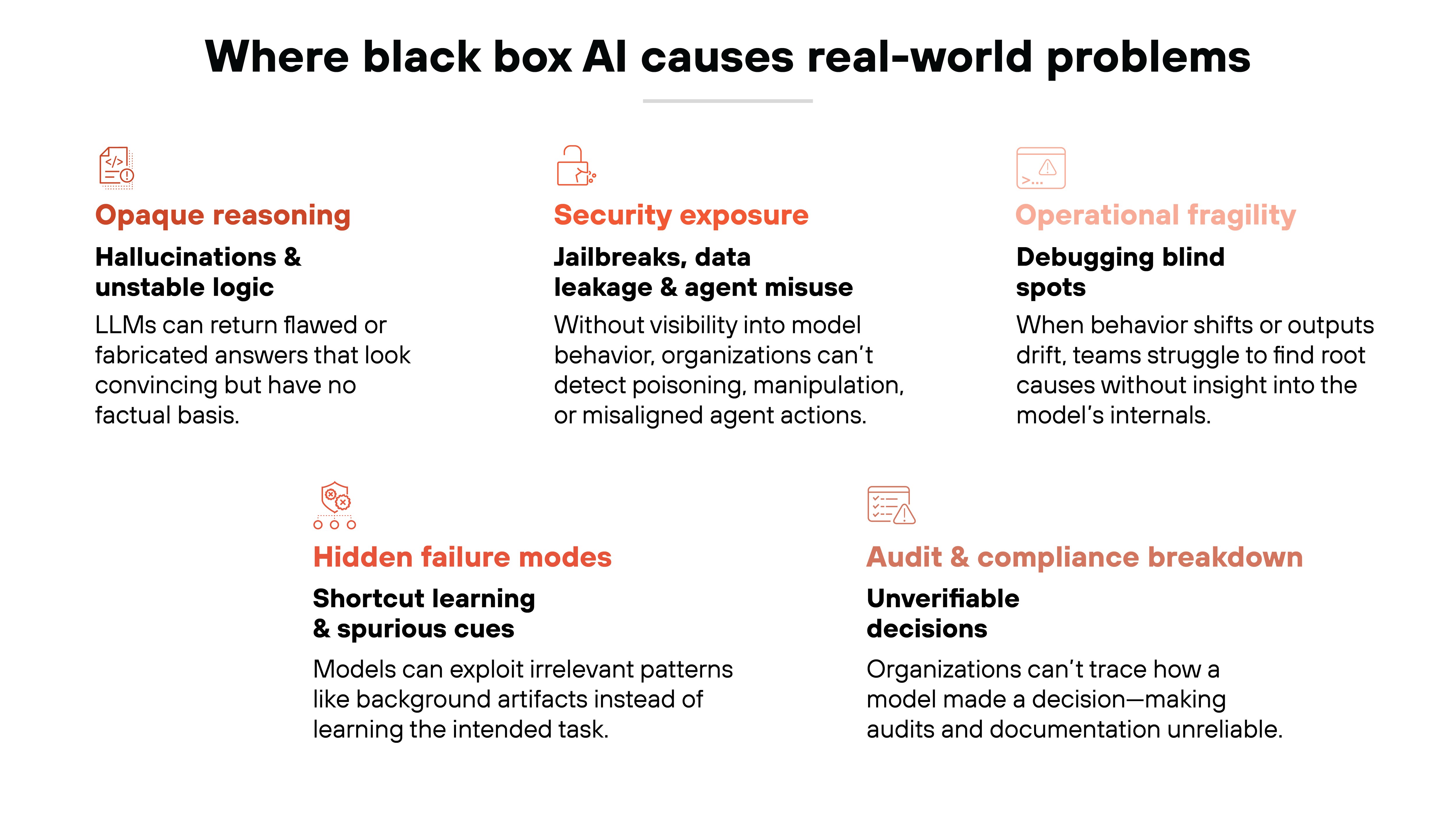
Bold black text at the top center reads 'Where black box AI causes real-world problems.' Six issue categories are arranged in two rows, each with an orange line-art icon, an orange heading, a bold black subheading, and descriptive text. In the top left, an icon of a document with code appears above the heading 'Opaque reasoning,' the subheading 'Hallucinations & unstable logic,' and text explaining that LLMs can generate flawed or fabricated answers that appear convincing but lack factual basis. In the top center, a lock icon appears above the heading 'Security exposure,' the subheading 'Jailbreaks, data leakage & agent misuse,' and text stating that without visibility into model behavior, organizations cannot detect poisoning, manipulation, or misaligned agent actions. In the top right, an alert symbol appears above the heading 'Operational fragility,' the subheading 'Debugging blind spots,' and text describing how shifting behavior or drifting outputs make root-cause analysis difficult without insight into internal mechanisms. In the bottom left, a gear-and-nodes icon appears above the heading 'Hidden failure modes,' the subheading 'Shortcut learning & spurious cues,' and text explaining that models can rely on irrelevant patterns such as background artifacts instead of the intended task. In the bottom right, a checklist with a warning icon appears above the heading 'Audit & compliance breakdown,' the subheading 'Unverifiable decisions,' and text noting that organizations cannot trace how a model made a decision, making audits and documentation unreliable.

Black box AI doesn't just make model behavior harder to understand. It makes the consequences of that behavior harder to predict, trace, or fix. And those consequences show up in ways that matter to reliability, safety, and security.

Opaque reasoning creates hallucinations and unstable logic paths.

LLMs can return answers that look confident but have no factual grounding. That includes fabricated citations, flawed reasoning, and incomplete steps. Which means users might act on something false without knowing it's wrong.

Hidden failure modes stem from shortcut learning and spurious cues.

Some models perform well in testing but fail in the real world. Why? Because they learn to exploit irrelevant patterns like background artifacts or formatting instead of the task itself. These weaknesses are often invisible until deployment.

Security exposure increases when behavior is untraceable.

Black box models can be poisoned during training. Or manipulated through prompts. Or misaligned in how they use tools and make decisions. That opens the door to jailbreaks, data leakage, or even malicious agent behavior.

Audit and compliance break down without transparency.

You can't validate how a model made a decision if you can't see what influenced it. That creates challenges for documentation, oversight, and meeting regulatory expectations around AI accountability.

Operational fragility rises when debugging is impossible.

Drift becomes harder to detect. Outputs vary unexpectedly. And organizations struggle to identify root causes when something goes wrong. That limits their ability to correct, retrain, or regain control.

Essentially, black box AI creates risks at every level of the AI lifecycle. And those risks are harder to manage when visibility is low.

| Further reading:

Free AI risk assessment
Get a complimentary vulnerability assessment of your AI ecosystem.

Claim assessment


How black box systems fail under the hood

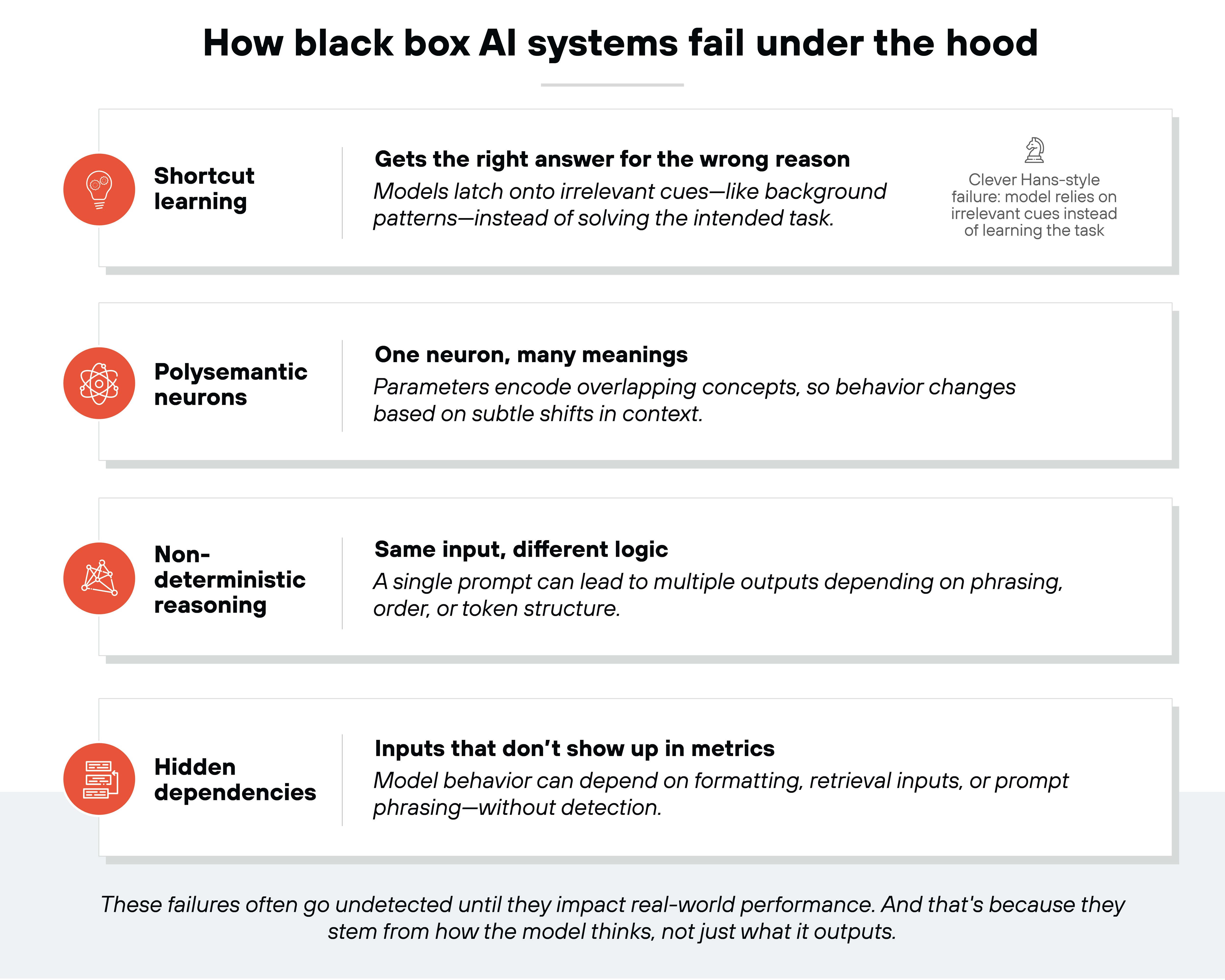
Bold black text at the top center reads 'How black box AI systems fail under the hood.' Four horizontal sections are stacked vertically, each beginning with an orange circular icon and a bold label on the left, followed by bold explanatory text and smaller descriptive text on the right. The first section shows a lightbulb icon beside the label 'Shortcut learning,' followed by the bold text 'Gets the right answer for the wrong reason' and a description explaining that models latch onto irrelevant cues such as background patterns instead of solving the intended task; a small gray illustration of a horse's head with text describes 'Clever Hans–style failure: model relies on irrelevant cues instead of learning the task.' The second section shows an atom-like icon beside the label 'Polysemantic neurons,' followed by the bold text 'One neuron, many meanings' and a description noting that parameters encode overlapping concepts, causing behavior to change with subtle shifts in context. The third section shows a triangular network icon beside the label 'Non-deterministic reasoning,' followed by the bold text 'Same input, different logic' and a description stating that a single prompt can produce multiple outputs depending on phrasing, order, or token structure. The fourth section shows a server-stack icon beside the label 'Hidden dependencies,' followed by the bold text 'Inputs that don't show up in metrics' and a description explaining that behavior can depend on formatting, retrieval inputs, or prompt phrasing without detection. At the bottom, centered italicized text reads 'These failures often go undetected until they impact real-world performance. And that's because they stem from how the model thinks, not just what it outputs.'

Black box AI systems don't just produce unpredictable results. They fail in ways that are hard to detect, and even harder to explain.

Here's what that failure looks like when you trace it back to the model's internals:

Some models get the right answer for the wrong reasons.

That's shortcut learning. The model might rely on irrelevant background cues or formatting artifacts instead of learning the task.

These Clever Hans-style failures (named after a horse that appeared to do math but was actually reading subtle human cues) often go unnoticed during evaluation and surface only after deployment.

Other models show signs of entangled internal structure.

That's because deep models encode multiple features into the same parameters.

Polysemantic neurons fold several unrelated patterns into the same unit. The same neuron might activate for both a shape in an image and a grammatical pattern in text. That shifting role makes it impossible to interpret what an activation ‘means.'

LLMs also show non-deterministic reasoning paths.

The same prompt can produce different responses based on prompt order, structure, or tiny variations in wording. In other words, the model's logic isn't fixed. It shifts with context.

Then there are hidden dependencies.

That includes formatting, instruction phrasing, or retrieval inputs. These variables shape how the model performs. But they don't show up in evaluation metrics.

All of this makes failure hard to catch. Especially when the underlying behavior can't be easily inspected.


How to reduce black box risk in practice

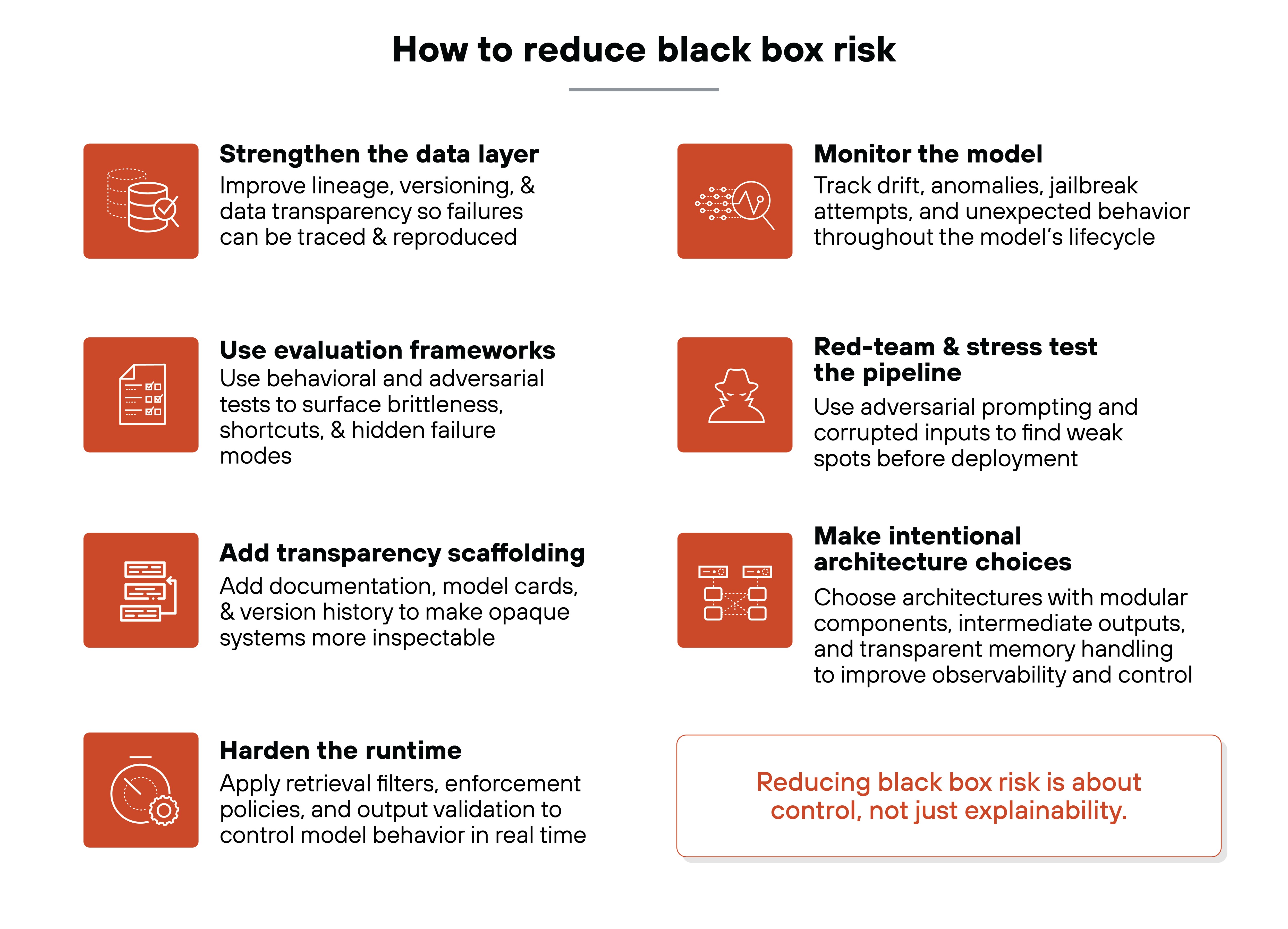
Bold black text at the top center reads 'How to reduce black box risk.' Eight guidance items are arranged in two vertical columns, each beginning with a rust-colored square icon, a bold heading, and descriptive text. In the left column, the first item shows a stacked-database icon beside the heading 'Strengthen the data layer' with text about improving lineage, versioning, and transparency to trace and reproduce failures. The second item shows a document icon beside the heading 'Use evaluation frameworks' with text describing behavioral and adversarial tests to expose brittleness, shortcuts, and hidden failure modes. The third item shows a stacked-module icon beside the heading 'Add transparency scaffolding' with text about adding documentation, model cards, and version history to make opaque systems more inspectable. The fourth item shows a gear-and-gauge icon beside the heading 'Harden the runtime' with text explaining the use of retrieval filters, enforcement policies, and output validation to manage behavior in real time. In the right column, the first item shows a magnifying-glass-over-dots icon beside the heading 'Monitor the model' with text about tracking drift, anomalies, jailbreak attempts, and unexpected behavior throughout the model lifecycle. The second item shows a silhouette-with-hat icon beside the heading 'Red-team & stress test the pipeline' with text describing adversarial prompting and corrupted inputs to find weak spots before deployment. The third item shows a modular-architecture icon beside the heading 'Make intentional architecture choices' with text recommending modular components, intermediate outputs, and transparent memory handling to improve observability and control. At the bottom right, a rounded rectangle with a thin border contains red text stating 'Reducing black box risk is about control, not just explainability.'

Reducing black box AI risk isn't just about making models explainable. It's about putting real-world controls in place that help organizations see, test, and manage opaque behavior across the lifecycle.

This starts before training. And it continues long after deployment.

Here's what that looks like in practice:

Strengthen the data layer

Black box AI problems often begin with poor data governance. That includes unclear lineage, undocumented transformations, and missing provenance.

When training data isn't well defined or versioned, failures are harder to trace and fix. So the model might be doing the wrong thing for reasons no one can reconstruct.

Data transparency is the foundation for downstream visibility and explainability.

Use evaluation frameworks

Standard model metrics don't reveal much about how a model thinks. That's why behavioral and adversarial testing is essential.

These methods simulate failure scenarios and test for brittleness, bias, or reliance on spurious patterns. Without them, many shortcut-driven failures won't surface until deployment. And at that point, the cost of fixing them goes up.

Add transparency scaffolding

Models don't explain themselves. But organizations can add scaffolding that makes them easier to understand and govern.

That includes documentation, model cards, version history, and intermediate reasoning traces. This won't make a black box model interpretable. But it does make it more inspectable.

And it supports oversight, even when internals can't be fully decoded.

Harden the runtime

Black box AI solutions shouldn't rely solely on training-time fixes.

Runtime guardrails reduce the risk of unsafe or non-compliant behavior. That includes retrieval filters, policy enforcement, output validation, and safety layers.

These systems don't explain the model. But they help control what gets through. And stop what shouldn't.

Monitor the model

Opacity makes ongoing monitoring critical.

Models can drift, degrade, or start behaving unexpectedly. But without visibility, those changes go unnoticed.

Monitoring tools should flag jailbreak attempts, prompt anomalies, or behavioral drift. This is especially important for systems that interact with users or external tools.

Red-team and stress test the pipeline

Explainable AI isn't enough.

Organizations need to probe their models the way attackers or auditors would. That includes adversarial prompting, corrupted retrieval inputs, or supply-chain manipulation.

The goal is to uncover weak spots before deployment. And to understand how models behave under pressure.

Make intentional architecture choices

Architecture plays a big role in interpretability.

That means choosing systems with intermediate outputs, isolatable components, and transparent memory handling. Agents and retrieval pipelines should be broken into modules with clear boundaries.

Like this, organizations can observe, control, and debug more of the process. Even when the model itself remains a black box.

INTERACTIVE TOUR: PRISMA AIRS
See firsthand how Prisma AIRS secures models, data, and agents across the AI lifecycle.

Launch tour


Where AI explainability actually helps (and where it doesn't)

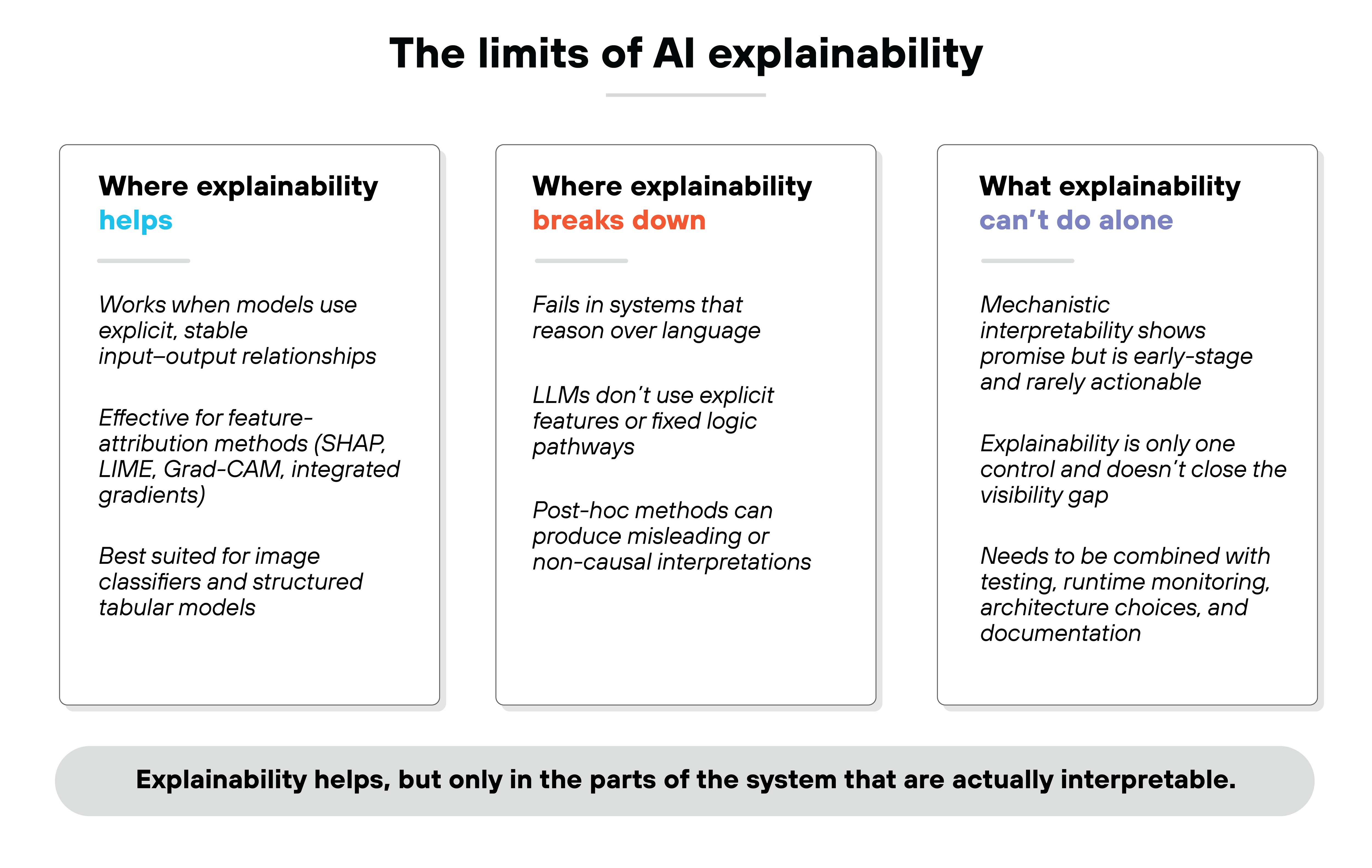
Bold black text at the top center reads 'The limits of AI explainability.' Three rounded rectangular panels are positioned side by side, each containing a heading, a faint gray underline, and multiple lines of descriptive text. The left panel is titled 'Where explainability helps' in black text with the word 'helps' in blue. Inside, text explains that explainability works when models use explicit, stable input–output relationships, is effective for feature-attribution methods such as SHAP, LIME, Grad-CAM, and integrated gradients, and is best suited for image classifiers and structured tabular models. The middle panel is titled 'Where explainability breaks down' in black text with the phrase 'breaks down' in orange. Its text states that explainability fails in systems that reason over language, that LLMs don't use explicit features or fixed logic pathways, and that post-hoc methods can produce misleading or non-causal interpretations. The right panel is titled 'What explainability can't do alone' with 'can't do alone' in purple. It describes how mechanistic interpretability shows promise but is early-stage and rarely actionable, how explainability is only one control and doesn't close the visibility gap, and how it must be paired with testing, runtime monitoring, architecture choices, and documentation. At the bottom, spanning the width of the image, a gray rounded rectangle contains bold text stating 'Explainability helps, but only in the parts of the system that are actually interpretable.'

AI explainability refers to techniques that help people understand why a model produced a particular output.

Different methods try to expose which inputs or patterns influenced a decision. But they only work when those patterns are represented in ways humans can interpret.

Explainability helps when it aligns with how the model represents information.

That includes feature-attribution methods like SHAP, LIME, Grad-CAM, or integrated gradients. These techniques are useful for models with clearly defined input-output relationships. Like image classifiers. Or models with structured tabular inputs.

But it breaks down in systems that reason over language.

LLMs don't use explicit features. Their logic shifts across context windows, token positions, and sampling temperatures. Which means post-hoc methods can mislead users into thinking they understand something that isn't actually interpretable.

Mechanistic interpretability offers another path.

It aims to reverse-engineer circuits or neuron roles in deep networks. That work has shown promise. Especially in cases like induction heads or attention pattern tracing. But the field is early. And the insights are rarely actionable for enterprise teams working with commercial models.

Important:

Explainability alone won't close the visibility gap.

It's just one control. And it works best when combined with testing, runtime monitoring, architecture choices, and documentation. That's how organizations start to manage the risks of black box AI in practice.


What's next for managing black box AI?

Visibility is no longer a feature you bolt on.

It's a system property. And it only works when built across the full lifecycle, from data design to model outputs.

Here's why that shift matters:

Security, reliability, and trustworthiness all depend on being able to observe how AI systems behave. You can't mitigate what you can't monitor. And you can't govern what you can't trace.

So where should organizations start?

With transparency scaffolding. Monitoring. Policy enforcement. Evaluation. Controls that reduce uncertainty—even when they don't fully explain the model.

Research is moving fast.

Mechanistic interpretability is uncovering new structures. Evaluation benchmarks are improving. And governance frameworks like AI TRiSM are beginning to reflect how fragmented, opaque systems actually work.

In the end, managing black box AI doesn't mean decoding every layer.

It means designing systems that stay visible, accountable, and aligned. Even when full interpretability isn't possible.

| Further reading:

Personalized demo: Prisma AIRS
Schedule a personalized demo with a specialist to see how Prisma AIRS protects your AI models.

Book demo


Black box AI FAQs
A black box AI system is one whose internal logic, representations, or decision processes are not understandable to humans, even when inputs and outputs are known.
Deep models encode information in high-dimensional spaces across many layers and parameters, making it difficult to trace how inputs lead to outputs or which features drive predictions.
Yes, especially in high-stakes domains. Black box AI can fail in ways that are hard to detect or explain, increasing risks around safety, fairness, and accountability.
Not fully. But we can use post hoc explanation tools, architectural choices, and runtime controls to improve visibility into black box behavior and reduce risk.
Interpretable models (like decision trees or linear models) show how inputs relate to outputs. Black box models (like deep neural networks) obscure that reasoning and require external tools to analyze decisions.
Yes. LLMs do not rely on explicit features or rules. Their responses emerge from distributed patterns across tokens, weights, and context windows, making their reasoning opaque.
Because deep models use overlapping, polysemantic representations. Their behavior arises from the combined activity of many components, not a single traceable rule or path.
Common tools include SHAP, LIME, Grad-CAM, and Integrated Gradients. These provide post hoc approximations of model behavior but can be misleading if the model’s structure doesn’t support interpretation.
Only with additional controls. Organizations must apply explainability techniques, auditing frameworks, runtime safeguards, and monitoring to meet compliance and safety standards.
Failures include biased medical diagnoses, incorrect credit scoring, or AI models relying on irrelevant features like background artifacts known as shortcut learning.