Service health and cost efficiency show the business impact of observability. They link system reliability to revenue and telemetry management to ROI. Historically, it was cumbersome for platform teams to customize and generate valuable views for executive leadership. Platform teams had to translate Service Level Objectives (SLOs) and data volumes into custom status reports. Cortex XCOR introduces Command Center to eliminate this manual step and give leadership clarity into service health and cost optimization metrics straight from the platform.
Instead of navigating individual service dashboards, leaders view health metrics structured by core business pillars, such as payments, fulfillment, or user authentication. Command Center also provides visibility into data optimization and associated cost savings across the platform.
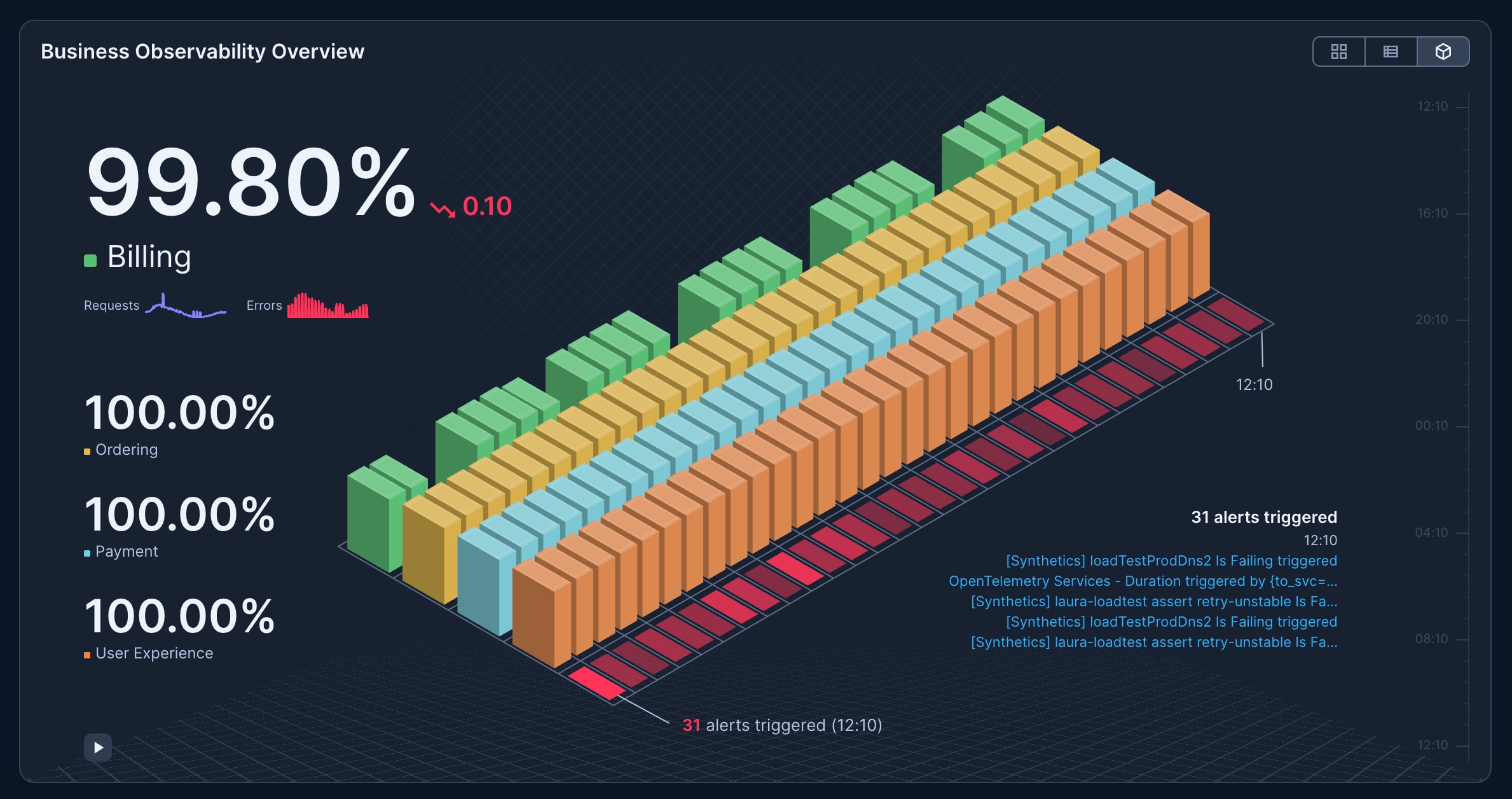
Translating Technical Signals into Organizational Context.
Communicating platform status to business stakeholders requires clear structure. Command Center gives executive leadership immediate visibility into system health by displaying a chart of triggered alerts across the environment alongside health indicators for configured business units. This layout gives executives a fast understanding of operational health without parsing complex dashboards or running queries.
For SRE and platform engineering leaders, this workspace demonstrates the business value of observability investments. Executives receive real-time visibility, while engineering teams control the underlying telemetry and operational workflows.
Grounding Business Health in Service Level Objectives.
Accurate health summaries depend on reliable underlying metrics. Command Center uses Cortex XCOR SLOs to power its business unit health panels. Grounding health in SLO compliance ensures status reflects true service performance and user experience rather than arbitrary static thresholds.
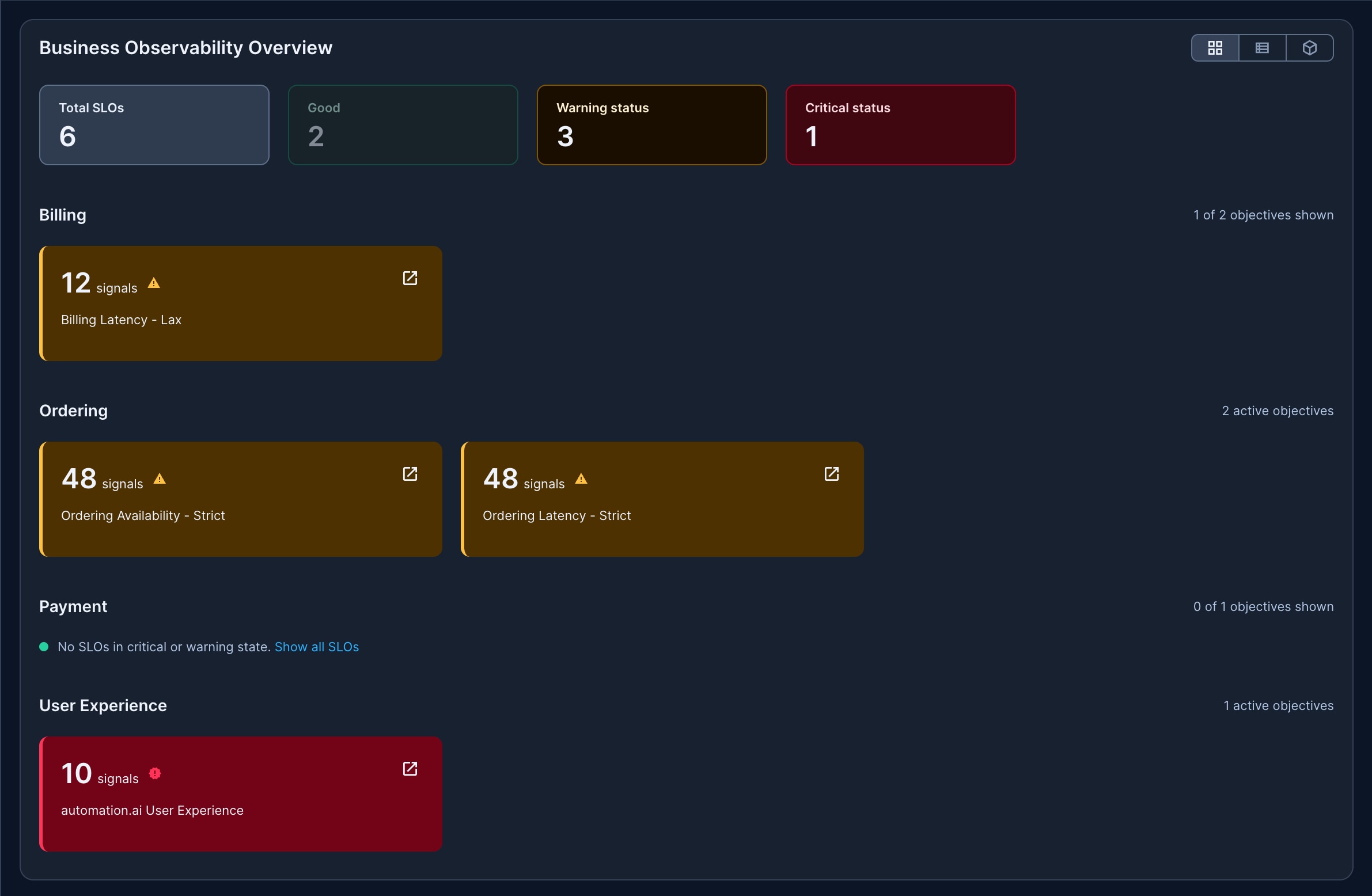
Setting up Command Center panels requires simple configuration. Platform admins create designated business units and assign driving SLOs. They then rank panels by priority and define the query for triggered alerts. Because Cortex XCOR SLOs handle metric definitions and endpoint discovery, engineering teams set up Command Center without heavy operational overhead or maintenance burdens.
Bringing Telemetry Efficiency and Cost Control to the High-Level View.
Besides reliability metrics and SLO health, Command Center shows high-level data efficiency metrics for telemetry throughput and cost management. Platform leaders no longer need to wait for monthly bills or run manual pipeline audits. They can review telemetry processing across the organization directly from the primary dashboard.
The cost optimization view displays four primary telemetry metrics across the environment:
- Total ingested data: Tracks raw metric, log, and trace data volume entering the pipeline before processing.
- Percentage reduced via optimization rules: Shows the proportion of telemetry volume that centralized rules reduce through label rollups, downsampling, or stripping non-essential log fields.
- Percentage dropped: Shows the percentage of unqueried or low-utility telemetry the platform removes at the ingestion point before persistent storage.
- Percentage persisted: Shows the exact percentage of high-signal data the platform stores and retains for querying, alerting, and incident triage.
By pairing throughput metrics with business unit health, platform leaders show executives how optimization rules control data growth while retaining the telemetry needed for production reliability.
Bridging Executive Oversight and Deep Engineering Drill-Downs.
As we rebrand Chronosphere to Cortex XCOR, Command Center establishes consistency between Palo Alto Networks products through a shared design language and workflow. This ensures leadership views business health through a unified framework across security and observability surfaces.
By connecting business unit status directly to technical signals, Command Center aligns executive reporting with engineering workflows. Executives gain clear visibility into operational health, while platform teams keep the technical depth required to resolve complex infrastructure issues.