Executive Summary:
Frontier AI enables adversaries to discover vulnerabilities and weaponize exploits in under 24 hours, while the defenders rely on an industry-average 55-day patching window, leaving enterprise networks dangerously exposed. Palo Alto Networks is closing this gap by introducing “Frontier Virtual Patching” through our new Advanced Threat Prevention Plus security service. Using proactive vulnerability discovery by NOVA - our Network and Open-Source Vulnerability Analyzer and early disclosures from Critical Defense Program (CDP), “Frontier Virtual Patching” moves beyond reactive IPS to deliver preemptive, vaulted protections before vulnerabilities are publicly disclosed or official patches exist. By combining pre-disclosure shielding with inline defenses powered by Precision AI®, Advanced Threat Prevention Plus can collapse the exposure window, automatically protecting critical systems at machine speed without requiring downtime, software restarts, or manual policy changes.
.................................................................................
For decades, cybersecurity relied on a predictable, human-speed timeline: a vulnerability was found, security vendors took days to craft an IPS signature for interim protection, and IT teams still had a couple of months to deploy the software patch. Frontier AI has completely shattered that timeline.
Once advanced frontier AI models are in the hands of bad actors, attackers will be able to automate vulnerability discovery, exploit generation, and data theft at unprecedented speed and scale. We are currently facing a vulnerability deluge, with over 23,000 total vulnerabilities surfaced by Project Glasswing as of May 2026, in which 6200 are estimated to be at high to critical severity.
In addition, the pace of attacks has quadrupled compared to the previous year. Findings from the 2026 VulnCheck Exploit Intelligence Report indicate that 29% of CVEs are now weaponized within 24 hours of being publicly revealed.
The Palo Alto Networks vulnerability research team built NOVA (Network and Open-Source Vulnerability Analyzer), a scalable, multi-agent framework powered by frontier AI models. NOVA moves beyond static code scanning to automatically discover, validate, and report zero-day vulnerabilities across open-source dependencies and software components before threat actors find them.
During an initial two-month validation run across 3,915 open-source projects, NOVA demonstrated the power of this approach:
- 14,090 validated findings generated autonomously.
- 99.4% of findings had no matching public record, CVE, or vendor advisory.
- Nearly 40% carried High or Critical severity ratings.
Historically, defenders relied on a margin of time. To wage a successful campaign, attackers had to discover a vulnerability, develop a reliable exploit, and weaponize it at scale which took weeks or months, allowing traditional Coordinated Vulnerability Disclosure (CVD) models to operate on the assumption of exclusive discovery.
The Dual Exposure Window
Once a vulnerability is discovered, the total exposure time isn't just one delay, it is the sum of two distinct operational bottlenecks:
Total Exposure Gap = Vendor Time to Release Patch + Customer Time-to-Deploy Patch
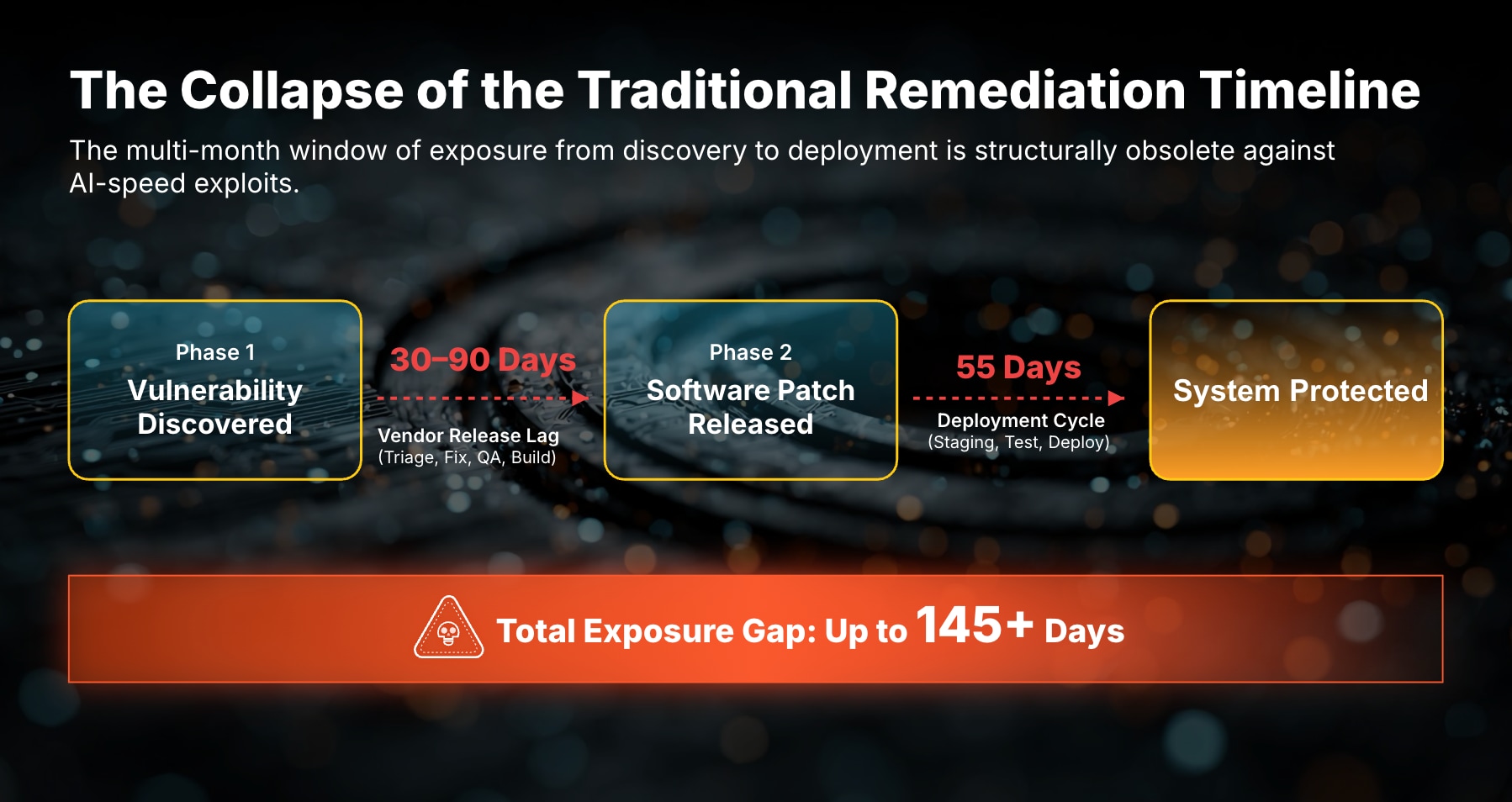
- Vendor Time-to-Release: Software vendors must reproduce the vulnerability, fix the root cause, run suites of regression testing, and release to customers, often across multiple supported versions of software. Even with agile teams, this often takes 30-90 days.
- Customer Time-to-Deploy: End users must ingest the advisory, test the patch in staging to ensure it won't break operations, schedule maintenance windows, and deploy. In industrial networks, this cycle often takes months. (As per Edgescan vulnerability report 2026 average enterprise application MTTR is 55 days)
When threat actors use automated AI agents to scan supply chains and generate exploits within 24 hours of disclosure, neither of these operational bottlenecks can move fast enough on its own.
In response to this shift in the vulnerability landscape, organizations are experiencing "patch panic." While enterprises strive to reduce the average 55-day window required to test and deploy software updates, patching alone will never be fast enough. Simply "patching faster" is no longer a viable strategy in the frontier AI era. Meanwhile, software vendors, OT manufacturers, and open-source maintainers are struggling with the deluge of AI-generated vulnerability reports, leaving enterprise networks exposed.
To help bridge this gap, security teams have relied on virtual patching, the practice of deploying network- or host-level protections (such as IPS rules) to detect and block exploit attempts before an official vendor patch can be deployed. Palo Alto Networks protects enterprise customers with virtual patching delivered via our next-generation firewall and SASE products, blocking billions of exploitation attempts at the network layer every day.
Effective Virtual Patching Requires Proactive Vulnerability Discovery and Pre-emptive Protection
Traditional virtual patching in its current form has reached its limit. The research and development of protections for new vulnerabilities relies on reactive and manual processes that are now far too slow compared to the speed with which frontier AI can discover and weaponize new vulnerabilities. Virtual patching must evolve. To counter AI-driven adversaries, we must shift to an automated, AI-native approach that discovers vulnerabilities, authors virtual patches, and deploys protections at scale within minutes, blocking attacks before they can ever be weaponized. Traditionally, protections for new vulnerabilities are delivered after the fact, triggered by a public disclosure, an in-the-wild attack, publication of security research or proof-of-concept attack code.
But in an era where AI models generate functional exploits within hours of disclosure, relying on this legacy timeline means that defenses arrive too late. Proactive vulnerability discovery and preemptive protection is the only way to close the exposure gap created by frontier AI.
Effective virtual patching must shift from reactive coverage to proactive discovery and preemptive protection.
Introducing “Frontier Virtual Patching”: a blueprint for preemptive defense
To give advantage back to the defenders we are introducing “Frontier Virtual Patching”.
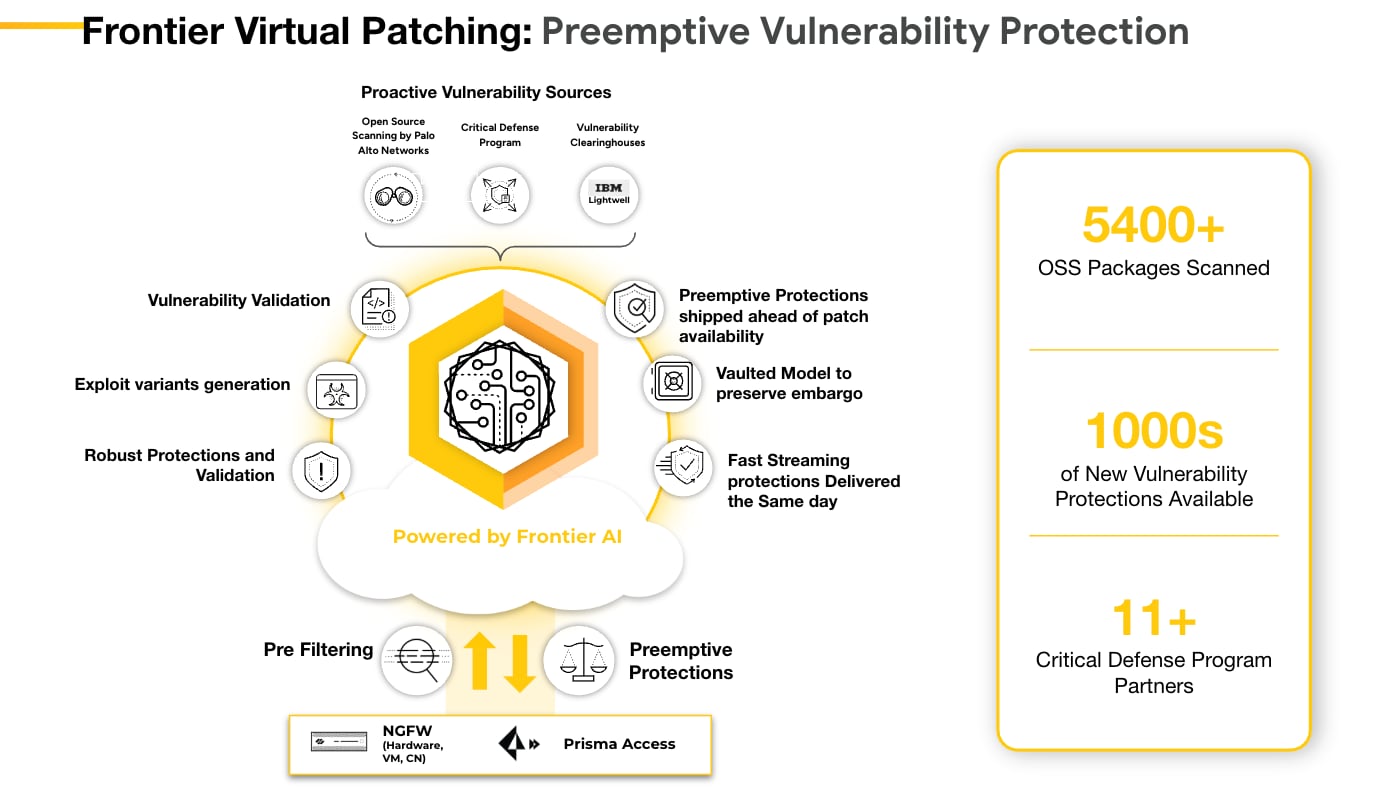
This capability does three things differently:
Proactive Vulnerability Discovery: Instead of the reactive process of waiting for attacks against new CVEs or public disclosure of vulnerability details, our solution proactively hunts for hidden vulnerabilities inside critical software, including both open source and commercial software.
- Open Source Discovery: Palo Alto Networks research uses our frontier AI harness (NOVA) to proactively detect and verify new vulnerabilities within thousands of critical open-source repositories.
- Critical Defense Program: CDP is the most comprehensive program in the industry to identify vulnerabilities as early as possible. Collaborators share existing CVEs or new, undisclosed vulnerability data with Palo Alto Networks, enabling us to provide rapid and comprehensive network protections (“virtual patches”) within hours of initial discovery to mutual customers. This program builds on our existing collaborations with IBM and Red Hat (as part of Lightwell), Microsoft (as part of MAPP) and OT leaders like Siemens and the Idaho National Laboratory (as part of the OT Threat Research Lab). We recently expanded the collaboration to include Anthropic, OpenAI, OT leaders like Mitsubishi and Axis Communications, industry consortiums for sharing risk information like Analysis and Resilience Center for Systemic Risk and Health-ISAC, OT research organizations like the independent, non-profit Energy R&D Institute (EPRI) and OSS initiatives like Akrites (an initiative from the Linux Foundation).
- Traditional Sources: We complement these proactive sources with over 20 traditional, reactive sources like in-the wild exploits, vulnerability feeds, bug bounties and commercial providers for public vulnerabilities.
Preemptive Virtual Patching: Protections preemptively shield your critical systems, often before vulnerability is publicly disclosed or an official vendor patch exists. “Vaulted protection” is a new technology innovation which enables preemptive protection of unpatched vulnerabilities without disclosing sensitive vulnerability details.
This approach drastically reduces the exposure window, locking down your most critical systems before an adversary even knows a vulnerability exists.
Frontier Virtual Patching extends the already best in class inline defenses of Advanced Threat Prevention
Palo Alto Networks Advanced Threat Prevention is the industry's first intrusion prevention system (IPS) that stops zero-day command-and-control (C2) attacks and unknown exploits inline, powered by Precision AI®. Extended with Frontier Virtual Patching, our new Advanced Threat Prevention Plus security service moves beyond reactive defense to deliver preemptive, pre-disclosure shielding across hardware and software firewalls (PA-Series, VM-Series, and CN-Series) and Prisma® Access.
Ultimately, this architecture bridges the dangerous gap between vulnerability discovery and remediation. By combining preemptive pre-disclosure defense with continuous real-time inline protection, Advanced Threat Prevention Plus enables your infrastructure to remain protected at machine speed, no matter how fast the threat landscape evolves in the frontier AI era.
Forward-Looking Statements
This blog contains forward-looking statements that involve risks, uncertainties and assumptions, including, without limitation, statements regarding the benefits, impact, or performance or potential benefits, impact or performance of our products and technologies or future products and technologies. These forward-looking statements are not guarantees of future performance, and there are a significant number of factors that could cause actual results to differ materially from statements made in this blog. We identify certain important risks and uncertainties that could affect our results and performance in our most recent Annual Report on Form 10-K, our most recent Quarterly Report on Form 10-Q, and our other filings with the U.S. Securities and Exchange Commission from time-to-time, each of which are available on our website at investors.paloaltonetworks.com and on the SEC's website at www.sec.gov. All forward-looking statements in this blog are based on information available to us as of the date hereof, and we do not assume any obligation to update the forward-looking statements provided to reflect events that occur or circumstances that exist after the date on which they were made.