Enterprises spent the last two years racing to capture the vast potential of AI, authorizing AI agents to touch production code, internal databases, customer tickets and financial ledgers. Because these agents operate non-deterministically with broad capabilities, they can easily be manipulated into unexpected or malicious behavior. The result is agents breaking out of isolation, shifting AI risk from a hallucinating chatbot to an operational liability.
The standard fixes, such as software containers or prompt-level guardrails, aren't sufficient to prevent malicious agent behavior. And traditional endpoint security was not designed to secure agents, which operate with real user access. Just as we pioneered XDR to include network, identity and cloud, we must now expand protection to secure agents in the enterprise.
Cortex XDR One brings together XDR and Koi Agentic Endpoint Security to protect both traditional system processes and AI agents, delivering layered enforcement across an agent’s execution path. XDR One is designed to control an agent’s actions at the source, enforce hard boundaries at the operating system level, and spot rogue behavior through an AI-driven layer of defense.
An Emerging Security Blind Spot
Endpoints have evolved from controlled execution environments into complex ecosystems of AI coding agents, AI co-pilots, MCP servers and personal agents with access to sensitive data and systems. These artifacts can bypass traditional controls and operate in critical blind spots.
When an agent ingests an untrusted input, connects to a compromised enterprise app or executes an unauthorized command, it transforms from a productivity tool into an active risk vector. Because agents operate with real user permissions and non-deterministic behavior, security teams face a compounding set of enterprise challenges that extend far beyond simple prompt injections.
Employees are adopting personal AI agents and browser tools that bypass IT oversight, spreading shadow AI across endpoints. At the same time, attackers are exploiting connected systems to manipulate these agents. By poisoning the external data, databases, or SaaS applications an agent relies on, adversaries can alter its behavior indirectly without ever touching the AI model itself. Without hard boundaries, an agent can be tricked into escalating host privileges, bypassing local containers or executing arbitrary system commands. In short, the agent escapes its intended sandbox and becomes an unwitting insider threat.
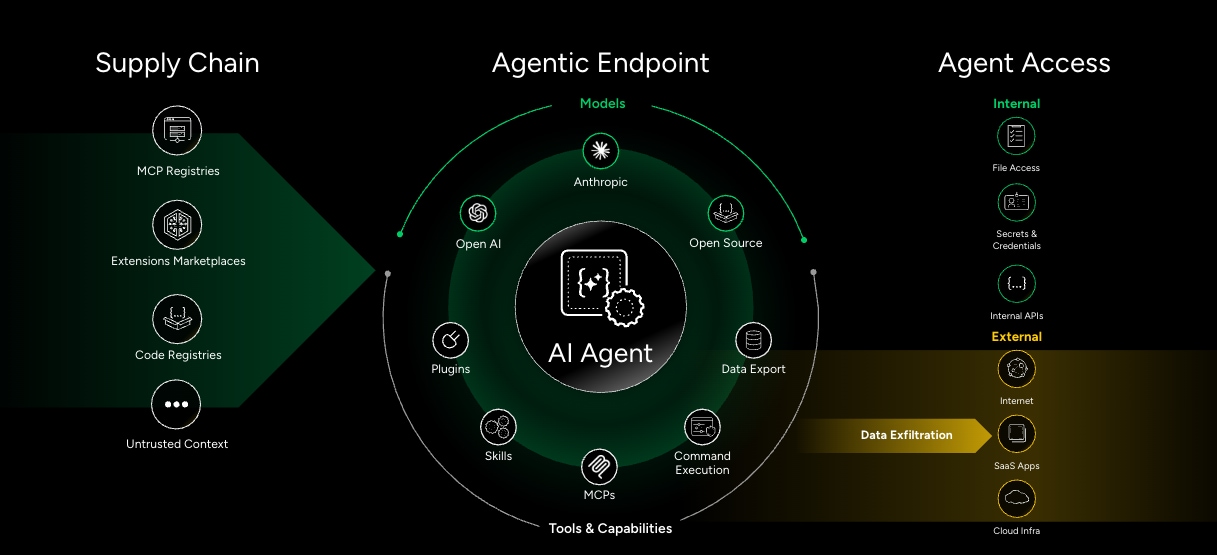
Adversaries are already exploiting this new vulnerability. In the ClawHavoc supply chain attack, adversaries targeted agents by uploading hundreds of malicious skills to OpenClaw's marketplace; once installed, these rogue skills broke runtime isolation to give remote attackers direct command-line access on the host. In a separate incident, Unit 42 research showed how agents can be tricked into revealing secret system prompts or sensitive information through indirect data poisoning from connected applications. Additionally, agents can bypass system and access controls when tricked into issuing unauthorized API calls or executing system tools under the guise of legitimate user permissions. Compounding these risks is the rise of shadow AI, as ungoverned, unmonitored agents deployed by employees silently inherit elevated system privileges without IT visibility.
When agentic AI was just emerging, we saw the potential risks it would bring and immediately sought out a solution to secure our internal AI workloads. Our InfoSec team found and deployed Koi while the startup was still in stealth mode. Impressed by Koi’s unique ability to secure new agentic endpoint behavior, we welcomed the talented Koi team into the Palo Alto Networks family to deliver this protection directly to our customers.
Cortex XDR One: Securing Every Endpoint and Agent from a Single Platform
XDR One integrates Cortex XDR and Cortex Agentic Endpoint Security with a single user interface and sensor, providing centralized visibility, management and investigation.
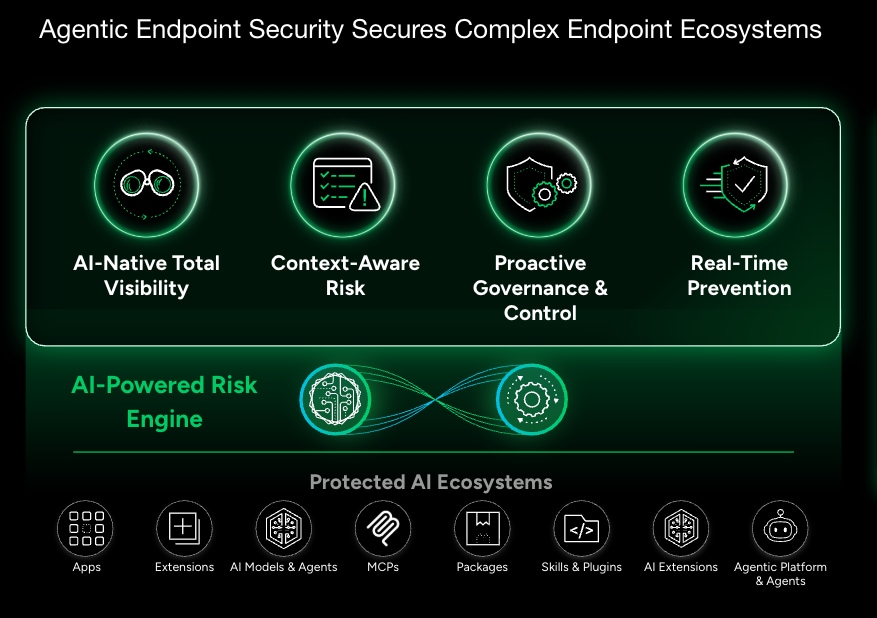
From sanctioned agents to shadow AI, XDR One gives teams a real-time inventory of every AI artifact the moment it appears on an endpoint. Armed with visibility into all the agent activity in the enterprise, security teams can control what packages, extensions, agents and AI artifacts are allowed to be installed or used. For example, a CISO can evaluate which vibe coding agents are actually being used by engineering teams and make an informed decision about the productivity impact of removing access to a specific agent.
Securing the modern endpoint requires unified defense across both the AI agent lifecycle and the underlying operating system. XDR One delivers this protection, from software installation to live execution. Within the agent layer, it enforces runtime guardrails to help stop prompt injections and destructive commands. Simultaneously at the OS layer, XDR One continuously monitors runtime process chains to block zero-day exploits and living-off-the-land attacks in real time without affecting performance. To complement these defenses, optimized small language models run directly on the endpoint sensor to guard against evasive, fileless threats even while offline and without sending sensitive code to the cloud. By stitching cross-domain telemetry into clear, end-to-end attack chains, XDR One cuts false positives by up to 95% and drives automated remediation in minutes.
Ultimately, consolidating this security telemetry onto a single sensor eliminates fragmented point tools and establishes a powerful operational foundation, equipping Cortex XSIAM with the critical data needed to better govern AI risk across the enterprise.
Flexible Protection with Standalone Agentic Endpoint Security or Native Integration
Cortex Agentic Endpoint Security (AES) specifically governs AI tools, MCP servers and agentic workflows running on those hosts. Organizations have the flexibility to deploy AES alongside existing third-party EDR environments using the Cortex targeted sensor.
However, organizations can simplify operations when AES and XDR come together natively in Cortex XDR One. By unifying agentic defense and extended detection and response into a single sensor and platform, XDR One bridges the gap between traditional host security and AI risks, delivering seamless visibility, management and real-time investigation.
Setting a New Baseline for Endpoint Security
The era of standalone EDR has passed. Just as XDR moved beyond siloed endpoint detection and response to encompass network, identity and cloud, securing the modern enterprise now demands native protection for autonomous AI workloads. EDR without integrated agentic security is incomplete and fundamentally legacy. Disconnected point solutions lack visibility into OS execution, while bolt-on EDR offerings fail to correlate the agent’s prompt and tool context with subsequent system behaviors. Relying on a bird of prey may seem like high-end security, until you discover it only swoops in after the wolf has already attacked the flock.
XDR One sets the new standard for endpoint security, providing unmatched visibility and preemptive control across both the OS and AI layers within a single sensor.
Scaling Enterprise AI with Confidence
While XDR One delivers complete standalone protection, security leaders grappling with this complex new attack surface can augment their team’s capabilities with Unit 42 MDR, which will now include Managed Agentic Endpoint Security. By combining XDR One telemetry with elite threat intelligence, Unit 42 experts deliver proactive threat hunting, incident investigation, and AI risk governance to strengthen overall resilience.
Securing the Agentic Frontier
As organizations race to adopt AI agents, security teams face a pivotal transition. The expansion of agentic capabilities across enterprise endpoints demands a security posture that treats agents with the same rigor and control as traditional system processes.
By unifying agentic endpoint defense and XDR into a single sensor and platform, XDR One sets a new standard for endpoint security in the agentic era. Whether deployed independently or backed by Unit 42 expertise, XDR One gives security leaders the visibility and control needed to eliminate shadow AI, enforce operational guardrails and accelerate their AI transformation.
Forward-Looking Statements
This blog contains forward-looking statements that involve risks, uncertainties and assumptions, including, without limitation, statements regarding the benefits, impact, or performance or potential benefits, impact or performance of our products and technologies or future products and technologies. Any unreleased services or features (and any services or features not generally available to customers) referenced in this or other press releases or public statements are not currently available (or are not yet generally available to customers) and may not be delivered when expected or at all. Customers who purchase Palo Alto Networks applications should make their purchase decisions based on services and features currently generally available.